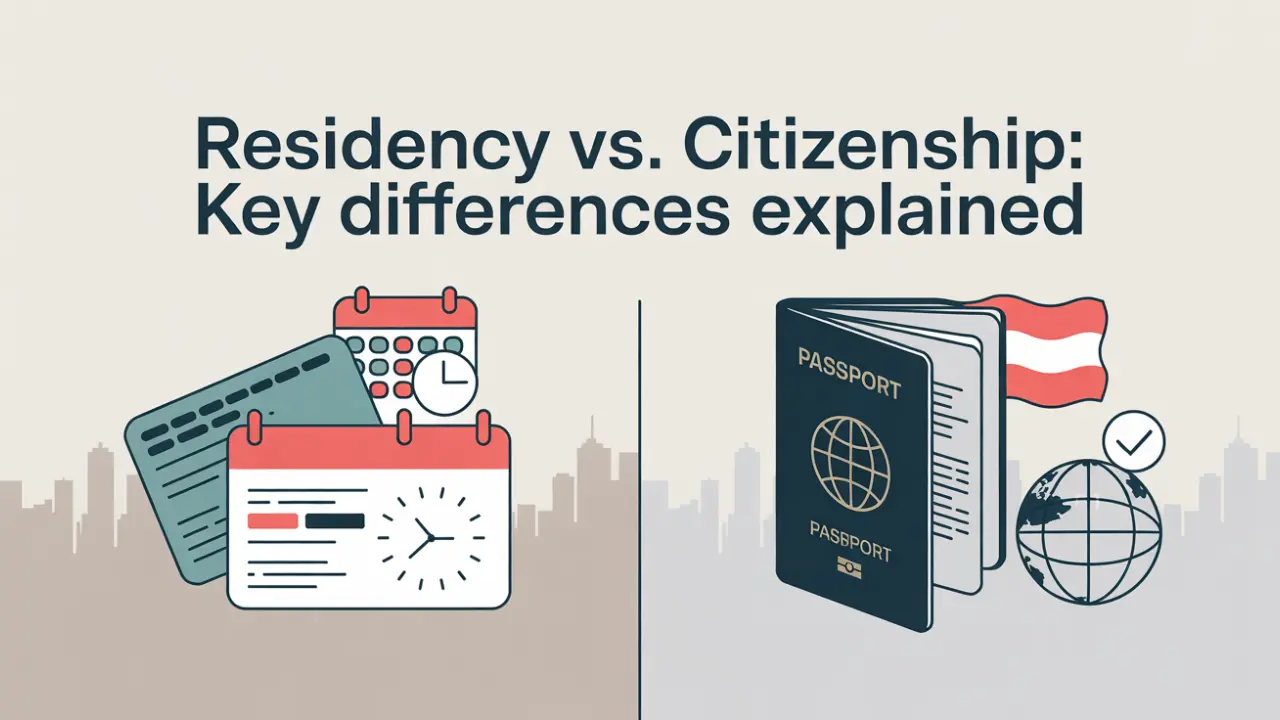
Understanding the concept of residency vs citizenship is highly critical for global investors. Most confuse different permits with full access to citizenship, but all these pathways have different types of ways and access to the resources of that country. Whether you’re going towards lifestyle upgrades, security, business opportunities, or the security of knowing the distinctions that ensure that you can make the right choice. Let’s break this down.
What Is Residency?
Residency simply means you get permission to live in another country for a long period of time. After fulfilling the requirements, you and your family can stay there, use healthcare, education, and enjoy most day-to-day benefits.
But it’s not permanent. Residency has to be renewed, and some countries ask you to spend a minimum number of days there every year to keep it active.
What Is Citizenship?
Citizenship is the highest status a country can give you. It means you are fully recognized as one of its own people and receive complete rights in that country. This includes the ability to vote, hold a national passport, and even run for public office in some cases.
Once granted, citizenship is usually for life unless you choose to give it up or it’s taken away under very rare circumstances.
Difference Between Residency vs Citizenship
Legal Status
The major difference between residency vs citizenship is actually permanence. The residence aspect is renewable (1-5 years), while citizenship is lifelong. A resident does not have the power to vote or hold a public office. Understanding the resident vs citizenship rights avoids any type of costly misunderstandings.
Travel Freedom
A residence permit is not a passport and does not give visa-free entry. It allows you to move within the Schengen Zone for short stays (subject to the 90/180-day rule) once you are already legally inside the Schengen area. For instance, a Malta Citizenship or St. Kitts holder can easily travel across Europe, while a resident must still present their passport along with their residence permit when crossing borders. This is a key aspect of permanent residency vs citizenship rights.
Timeline
Citizenship vs residency timelines can easily differ in sharp ways. Residency applications can easily take around 6 months to 9 months (for instance, the UAE Golden Visa takes 2 to 3 months). Citizenship programs generally take around 3 months to 6 months but require actual prior residency. Planning this timeline is key towards aligning for life goals.
Investment Requirements
Residency often has actual lower entry costs: Portugal (€400K), Greece (€250K). Citizenship aspects programs, as in St. Kitts ($150k donation) or Turkey ($400k real estate), require higher investments. Always check in hidden fees—legal costs, due diligence, and family additions that can be around 10 to 20% for it to be total.
Renewal & Physical Presence
Residency usually requires renewal after every 1 to 5 years and requires physical presence (e.g., Portugal mandates 7 days/year). Citizenship is permanent with almost no renewal or residency requirements. This actually makes residency vs citizenship an important factor for all the frequent travellers or the digital nomads.
Tax Implications
Residency generally is subject to local taxes for the income earned in that country. Citizenship can trigger worldwide taxation (e.g., US citizens pay their taxes on a global level), but countries like Turkey or the UAE generally use territorial tax systems—only local income gets taxed. Do consult a tax expert before you go for this process.
Family Eligibility
Family eligibility depends on the country and the type of program you choose. Most residency and citizenship-by-investment routes allow you to include your spouse and dependent children, and some also accept dependent parents. However, the age limits and dependency rules can vary, especially for older children. Because each program is different, it’s important to review the specific requirements before assuming a family member qualifies.
Residency vs Citizenship: Side-by-Side Comparison
Feature | Residency | Citizenship |
Duration | Temporary (renewable 1–5 years) | Permanent, lifetime status |
Travel Rights | Limited movement within Schengen once inside | Global visa-free access with a national passport |
Political Rights | No voting or public office | Full voting and political rights |
Taxation | Usually taxed only on local income | Some countries tax global income |
Cost Range | Lower investment threshold | Higher investment threshold |
Renewal Requirements | Must meet stay requirements | No renewal, no physical presence needed |
Family Inclusion | Spouse, children, sometimes parents | Spouse, children, future generations |
Path to Passport | Often available after 5–7 years | Already granted |
Benefits of Residency by Investment
- Lower Costs: Starting with €200k to €300k for investments.
- Path for Citizenship: Most countries (Greece, Malta, Portugal) allow a pathway to citizenship after maintaining residency for 5 to 7 years
- Lifestyle upgrades: Getting access to schools, healthcare, and a great quality of life without any kind of full citizenship.
- Flexibility: Great for part-time residents, along with those who want to test out a country before going for a long-term choice.
Benefits of Citizenship by Investment
- Global Mobility: Visa-free travel across 120+ countries (For instance: The St. Kitts passport covers this for UK, EU and Canada)
- No Renewal: Lifetime status along with no residency rules.
- Business Advantages: Easier to open for international bank accounts and expanded globally along with project assets.
- Security: Protection from political instability in your home country.
Also Read: What is the Procedure for Greece Citizenship by Investment?
Popular Countries for Residency by Investment
Portugal
- Investments: €200k for real estate otherwise €150k in low-density areas.
- Processing: For 8 months to 10 months.
- Benefits: Freedom to travel within the Schengen area for short stays after entering Europe with your passport.
Greece
- Investments: €250k for property purchase.
- Processing: For 3 months to 6 months.
- Benefits: Access that’s visa-free for 29 countries, and no physical residency is required.
UAE / Dubai
- Investment: $550k for property or $275k for government bonds.
- Processing: around 2 months to 3 months.
- Benefits: Almost zero income tax along with visa-free travel for 15 countries and almost no residency requirements.
Popular Countries for Citizenship by Investment
Malta
- Investment: €100k contribution
- Processing: Around 12 to 36 months, depending on the route.
- Benefits: EU citizenship & visa-free travel for countries like Canada, the UK, the Schengen Zone, and more.
- Family Benefits: Children under 18, spouse, and dependent parents.
Caribbean Nations
- St. Kitts & Nevis: $200k real estate or $150k donation.
- Dominica: $200k real estate or $100k donation
- Grenada: $200k for real estate that includes US E-2 visa access.
- Processing: For 3 months to 6 months.
Which Option Is Better for You?
Choose Residency If You Want:
- Lower investment requirements
- Flexibility without long-term commitment
- Access to healthcare, education, and residence rights
Choose Citizenship If You Want:
- Immediate second passport for global mobility.
- Business expansion as well as asset protection.
- Complete political rights (public office, voting)
Also Read: How to Get Malta Citizenship after Permanent Residence?
Common Mistakes People Make When Choosing
Common Mistakes People Make When Choosing Citizenship vs Residency
- Assuming residency directly means you get citizenship (this requires separate applications).
- Ignorance of tax implications, citizenship that means worldwide taxation.
- Overlooking of family inclusion rules (e.g., some of the programs that exclude adult children).
- Choosing based on price alone without considering processing times or the renewal requirements.
Frequently Asked Questions
What is the main difference between residency and citizenship?
Residency is temporary and must be renewed, while citizenship is permanent and comes with full rights, including voting, a national passport, and broader global mobility. Residency provides important local benefits, but it does not include political rights.
What is the easiest country to get residency by investment?
UAE – $550K and around 2 to 3 months; Greece – €250K property for 3 to 6 months; these are the simplest. Both have minimal physical presence requirements along with straightforward applications. For beginners, these can offer the smoothest and simplest entry.
What is the difference between a resident vs a citizen in terms of rights?
The difference of resident vs citizenship is that residents are not allowed to vote or hold public office or access diplomatic protection. Citizens do enjoy complete political rights along with multiple passport privileges and lifelong security.
Is citizenship by investment permanent?
Yes, the way of citizenship by investment is permanent and actually renewable for life. Unlike the residency factor, citizenship will never expire and does not need any kind of renewal. However, many countries do require an investment for around 3+ years.
Conclusion
Deciding between residency vs citizenship directly depends on your goals. If you want the lower costs and adjust with some flexibility, residency is your choice. For better and lifelong security and business growth, citizenship is perfect for you. Do consult the experts for navigation of complicated rules and regulations—because this is the right choice, not just an investment, but also for building a great future that can fit your needs.