A greatly picturesque island nation in the Mediterranean, Malta, provides for the most sought-after and highly praised European citizenship that paves the way for global investors. For the CBI (Citizenship By Investment) program started by the Malta government, this way provides direct access to citizenship in this island nation. Where the CBI permanent citizenship provides a permanent residence first, along with neutralization for meeting the residency requirements. This type of path ensures that the citizenship is done in a smooth manner, and Malta Citizenship by residency can help you indulge in the Maltese society while you can leverage the strategic partnership for EU membership, high-quality life & healthcare. In this detailed guide we will help you with each step of the process, from securing Malta permanent residence by investment to how to get malta citizenship after permanent residence.
Methods to Secure Permanent Residence in Malta
These are the different methods for Malta citizenship requirements
Malta Permanent Residence Programme (MPRP)
This is the cornerstone for Malta’s residency through an investment framework called MPRP, or Malta Permanent Residence Programme, that is generally referred to as the Malta Golden Visa. This program generally allows for obtaining long-term residency with the help of qualifying investment. Unlike the different EU countries, the residence is before approval, thus making it a great deal for the entrepreneurs and professionals.
Residency Under the CES (Citizenship by Naturalization for Exceptional Services) Route
While the CES route can actually grant citizenship for the different exceptional contributions (for instance, cultural, scientific, and economic achievements), this can serve as the pathway for the residency for the selected criterion. Although this route is specifically selective and generally reserved for the individuals with specific profiles and high-profile people. For most of the MPRP remains actually the preferred starting point for the Malta Citizenship by Residency program.
The Malta Permanent Residence Scheme Explained
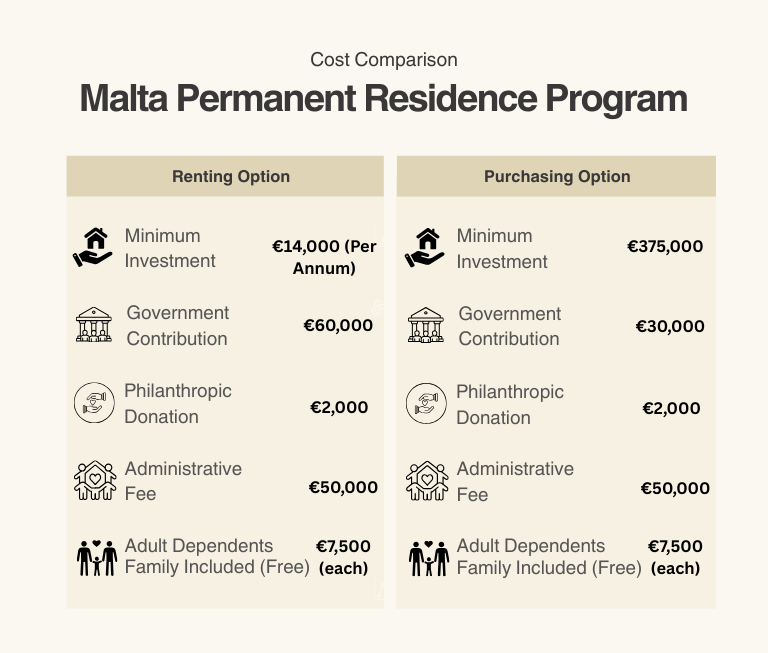
The MPRP scheme requires a minimum amount of investment of around €375,000, with around €37,000 for government contribution, totalling €405,000. Applicants need to purchase or lease the property in Malta (a minimum of €375,000 for purchasing or around €14,000/yr based on rental). The program does allow for family inclusion that includes spouses and children below 18 years and parents under the age of 55, thus making it great for multi-generation relocation.
Cost Breakdown for Malta Permanent Residency
This is the cost breakdown for Malta permanent residence program:
- Government Fees: €37,000 contribution (non-refundable).
- Real Estate: €375,000 for the minimum investment (property purchase for the long-term lease)
- Due Diligence: €5,000 to €10,000 for each applicant based on the background checks.
- Family Member Costs: Around additional costs of €7,500 for each Adult Dependents.
These types of costs can directly ensure compliance with Malta’s strict regulatory standards while providing for a transparent investment structure.
Eligibility Criteria for Malta Permanent Residency
These are the requirements for the Malta Permanent Residence Program; applicants must:
- The applicant has to be 18 years old.
- Having a clean and clear criminal record.
- Demonstrate sufficient financial means for supporting themselves and dependents.
- Making the required investment for the Maltese real estate for the government bonds.
- Passing rigorous due diligence checks.
Also Read: What It’s Really Like Living in Malta as an Expat
Step-by-Step Procedure for Obtaining Malta Residency via Investment
Initial Consultation: Engaging with a licensed agent (like NxtCitizens) for assessing eligibility.
Document Preparation: Birth Certificates, Compile passports, financial proofs, and police clearances.
Due Diligence Submission: Paying fees along with submitting documents for the different background checks.
Investment Execution: Leasing/purchasing property along with transferring funds.
Application Approval: Receiving a residency permit for 4 to 6 months.
Residency Maintenance: Renewing residence in an annual manner and maintaining investments for 5 years.
Benefits of Malta Permanent Residency
Holding the Malta PR grants visa-free travel across the Schengen Area (for 29 countries), access to world-class healthcare along with education, and the ability to live along with working there and even study in Malta. This actually serves as the foundation for the Malta Citizenship by naturalization after the basic fulfillment of the residency requirement.
Requirements for Maltese Citizenship Through Naturalization
After holding the Malta PR requirements for around 5 years, applicants have a window to apply for citizenship through naturalization. Some of the requirements include:
- Physical residence based in Malta for around 12 months before the application process.
- Maltese Language Proficiency for B1 Level.
- Knowledge of culture and history.
- Renunciation of previous citizenship (unless the dual citizenship that’s permitted)
Cost Factors for Malta Citizenship Naturalization
While the initial PR investment can cover residency, citizenship naturalization can incur additional fees:
- Government processing fee of €1,500.
- Culture and Language fees of €200–€500
- Administrative & Legal Costs of €5,000–€10,000.
This amount of fees is actually lower than the €600,000+ that’s required for direct-based citizenship for Malta’s CBI program, making the residency for citizenship cost-effective.
Step-by-Step Guide to Applying for Maltese Citizenship by Naturalization
This is the right step-by-step guide to applying for Malta residence by investment:
- Residency Period: Maintaining a PR status for around 5 years.
- Language Tests: Passing a certified Maltese language test for 5 years.
- Application Submission: Filling forms for Malta’s identity Malta Agency.
- Oath of Allegiance: Attending a citizenship ceremony
- Passport Issuance: The Malta passport will be issued to you in 6 to 8 months.
Malta PR vs Malta Citizenship: Key Differences
Aspects | Malta Permanent Residency | Malta Citizenship |
Travel Rights | Schengen visa-free accessibility | EU passport alongwith global visa-free travel |
Duration | Renewable per year | Lifetime (although with due diligence) |
Tax Implications | Non-domicile tax structure | Worldwide taxation (with certain exemptions) |
Pathway for EU Rights | Limited (residency only) | Full level EU citizenship rights |
Investment-Residence Schemes in Other European Countries
Malta’s MPRP does compare for the favorability for other EU programs:
Portugal: €200,000 for real estate investing (Golden Visa).
Greece: €250,000 for property purchase (Golden Visa).
Cyprus: €2 million for investment (Citizenship by Investment).
Malta is known for its short processing times of 4 to 6 months along with lower overall costs for the citizenship for residency.
How to obtain Citizenship in Malta after Permanent Residence
Obtaining Maltese citizenship after obtaining permanent residency requires a second, merit-based naturalization process. The Malta Permanent Residence Programme (MPRP) provides lifelong residency but fails to issue a passport. Applicants for citizenship have to qualify under the new “Citizenship by Merit” standards, which look at outstanding services or achievements to Malta.
Major Considerations about Malta’s Permanent Residency and Citizenship Routes
These are some of the major considerations about Malta’s permanent residency and citizenship routes:
- Dual Citizenship: Malta does permit dual citizenship, but for countries like China or India, that can require renunciation.
- Tax Planning: The traditional taxation system in Malta does provide benefits to only non-domiciled residents.
- Due Diligence: Massive regulatory checks do mean transparency as well as financial stability are non-negotiable factors.
Is Malta Permanent Residency Right for You?
The Malta permanent residence program is great for investors that are seeking EU residency without any kind of citizenship demands and requirements. If you have a goal of EU integration for a clear path for the Malta permanent residence program, this is a clear path that provides unparalleled flexibility. For people who want faster ways of getting Malta citizenship, the route of CBI can be a great option for them for cultural integration along with lower costs.
By choosing Malta, you’re investing in a passport; you’re actually securing a future in one of the most stable, along with English-speaking, nations. Whether you’re a retiree or a business owner or a family that’s seeking global mobility, the Malta Citizenship by Residency is a great way towards providing a structured and transparent route for European citizenship.
Frequently Asked Questions
What are the advantages of a Maltese passport and permanent residency?
Maltese passports that grant EU citizenship along with visa-free travel for around 180+ countries along with tax benefits. Permanent residency that provides Schengen access, education, and healthcare along with a clear path for citizenship—that’s ideal for mobility and security.
Who qualifies for Malta citizenship and permanent residency?
From the clean criminal record for around €375k investment (for gov bonds/property) + €30k fee for the due diligence approval. Family and members (kids <18, spouse & parents >55). No prior residency is needed for PR.
What steps are involved in getting a Malta passport?
After 5 years around for PR, passing the B1 Maltese test, and submitting an application along with taking an oath. Requires 12 months for physical residency. Processing time can take around 6 to 8 months for the issuance of a Malta passport.
What are the costs associated with Malta citizenship by naturalization?
The government fee is €1,500, and the language tests are €200-500, along with legal costs for €5k-10k. Totaling these Malta citizenship costs €6.7k-11.5k. No investment can be beyond the initial PR requirements. Processing can take around 6 months for the residency period.